What does awl mean in slang?
awl meaning slang, In digital slang, awl most commonly stands for “Always With Love,” used as an affectionate text sign-off. Alternatively, Gen Z and TikTok cultures frequently use it as a phonetic, stylized spelling of the words “all” or “aww” to express intense cuteness or community support.
Why is the awl slang meaning trending across social media?
- Micro-Validation: It serves as a rapid, text-based emotional shorthand to transfer genuine warmth, safety, and security between close friends without sounding overly dramatic.
- Algorithmic Visibility: The phonetic variation “awl” is highly viral within USA lifestyle subcultures, driving high engagement in Instagram DMs and short-form video comment feeds.
- Conversational Efficiency: It neatly condenses complex digital expressions into three letters, bridging the gap between traditional prose and fast-paced modern internet dialect.
What Does AWL Mean?
The slang acronym AWL most commonly stands for “Always With Love” in modern text messages and social media feeds, serving as a digital sign-off to show deep affection, support, or a virtual hug. Alternatively, depending on the younger demographic using it, AWL functions as a phonetic, stylized spelling of the word “all” or the emotional sigh “aww” to express that something is incredibly cute or overwhelming.
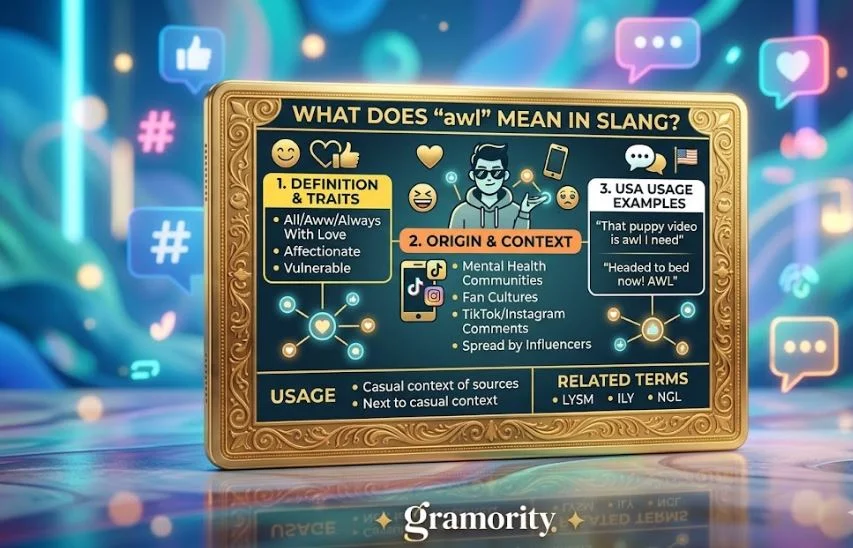
When you see a close friend drop this term in your direct messages or comments, they are injecting a layer of pure positivity into the conversation. It streamlines emotional vulnerability into three letters, making it incredibly easy to show someone you care about them without writing an entire paragraph.
Strong Introduction
Navigating the ever-shifting currents of American internet culture can feel like trying to decode a brand-new language every single week. Just when you think you have mastered the current shorthand, a new three-letter combination takes over your feed, leaving you scratching your head. Lately, the term AWL has been popping up across major social networks, popping up in casual texts, live stream comments, and personal bios alike.
People are searching for this term because its meaning changes drastically depending on who is typing it and where it appears. It solves a massive point of digital confusion, bridging the gap between standard speech and fast-paced keyboard culture.
If you have ever wondered whether a friend was sending you heartfelt affection or simply making a strange typo, you are not alone. Understanding this subtle piece of modern dialect helps you stay closely connected to the actual emotions behind the screen.
awl meaning slang – Quick Meaning
At its core, this digital term acts as an emotional Swiss Army knife for quick communication. It condenses genuine human warmth into a tiny footprint. Here is a quick snapshot of what it looks like when put to use:
- Primary Definition: Always With Love (Used as a warm sign-off or supportive reaction).
- Secondary Definition: A stylized phonetic spelling of “all” or “aww” (Used for intense emphasis or reacting to cuteness).
- Texting Purpose: To instantly validate a friend’s feelings, offer comfort, or close out a conversation on a beautiful note.
“Headed to bed now, good luck on your big presentation tomorrow morning! AWL.”
“That puppy video you just sent me is awl the motivation I need to get through this exhausting workday.”
Origin & Background
The journey of this slang term is a perfect example of how language evolves from strict structural origins into fluid, emotion-driven expressions. Decades ago, the closest written relative to this term was the military acronym AWOL, which stands for Absent Without Leave. Over the years, early internet forums in the 2000s saw occasional typos where people dropped the letter O, using the shorter version to imply someone was missing or slacking off.
However, the modern usage we see today took a completely different path. It blossomed out of online communities dedicated to mental health awareness, fan cultures, and close-knit friendship circles on Instagram and TikTok. Users wanted a way to sign off their supportive comments without sounding overly formal or repetitive. As the fast-paced culture of short-form video content grew, typing out lengthy phrases became less appealing to younger users. The phrase transformed into a comforting stamp of approval, spreading rapidly through lifestyle influencers and daily comment sections until it became an established staple of current text-based communication.
Real-Life Conversations
Seeing this expression inside an isolated definition is one thing, but watching it function in real life shows you its true utility. Here are a few authentic scenarios showing exactly how everyday people use it in their conversations:
Scenario 1: Instagram DMs
Sarah: I am feeling incredibly overwhelmed with these final exams. I don’t think I have enough time to study everything.
Chloe: Take a deep breath, you have worked so hard all semester and you are going to absolutely crush it! AWL.
Scenario 2: TikTok Comments
Marcus: Just posted my first vocal cover after being terrified of singing in public for years.
David: This sounds absolutely incredible man! We are awl so incredibly proud of you for putting yourself out there.
Scenario 3: Text Messages
Jake: Hey, I just wanted to say thank you for helping me move into my new apartment yesterday. I couldn’t have done it without you.
Ryan: Of course! That is what best friends are for. Let me know when the place is settled. AWL.
Scenario 4: WhatsApp Group Chat
Emily: Are we still on for dinner at that new Italian spot downtown tonight?
Jessica: Yes, awl of us are totally ready to eat some amazing pasta! See you at seven.
Why is it viral right now? This term is trending heavily in American culture because our digital interactions require a balance between speed and emotional depth. People are exhausted by dry, robotic interactions. They want to express empathy and community, and using this shorthand allows them to do exactly that in a single, effortless keystroke.
Emotional & Psychological Meaning
Using this shorthand goes far deeper than simply saving a fraction of a second while typing on a glass screen. From a psychological perspective, it serves as a digital safety net. Expressing deep, affectionate feelings can sometimes feel heavy or uncomfortably vulnerable in a casual text conversation. By channeling those heavy emotions into a lighthearted, widely accepted acronym, users can extend genuine warmth without making the interaction feel overly dramatic.
Modern communication relies heavily on micro-validations. When someone adds these three letters to a message, they are intentionally signaling that the relationship is safe, stable, and filled with positive intent.
Think of a scenario where a daughter is frantically text-messaging her mother about a stressful day at her new job. The mother responds with a supportive message and finishes it with these three letters. That tiny addition instantly lowers the recipient’s cortisol levels, providing a distinct sense of home and security across miles of digital space. It proves that even within our highly accelerated, short-form culture, our fundamental human need for emotional safety always finds a way to break through.
Usage in Different Contexts
Context changes everything when it comes to internet slang. Using this phrase with a childhood friend feels entirely different than using it with someone you barely know.
Social Media
On platforms like Instagram, TikTok, and internet forums, this expression lives in the comment sections. It is a fantastic tool for creators who want to show gratitude to their fan bases or for users leaving encouraging notes on a friend’s latest photo. It acts as a beacon of positivity in spaces that can often turn toxic.
Friends & Relationships
This is where the term truly thrives. Between romantic partners or long-time friends, it functions as a warm, cozy blanket at the end of a long conversation. It is an easy way to say “I love you” or “I am always cheering for you” when a full, emotional conversation isn’t practical.
Work & Professional Settings
You should generally avoid using this acronym in professional emails or corporate messaging channels. Sending this to your project manager or a corporate client can easily blur professional boundaries and look highly unprofessional. Stick to traditional, clear sign-offs when dealing with work matters.
Casual vs. Serious Tone
The expression handles casual environments beautifully, but you must be careful during intensely serious moments. If a friend is sharing deeply painful news or experiencing a severe crisis, using a casual three-letter slang term can sometimes feel dismissive or lazy. In those raw moments, take the time to type out your comforting thoughts in full, authentic words.
When NOT to Use It
While this expression is incredibly versatile, there are specific boundaries where using it becomes a mistake. You must recognize these boundaries to keep your digital communication smooth and respectful.
Avoid using this term when discussing formal legal matters, medical situations, or official academic disputes. Furthermore, when communicating with individuals who are entirely outside of internet culture, dropping this term will likely leave them entirely confused, forcing you to explain the definition anyway.
True linguistic expertise means knowing exactly when to use a trendy phrase and when to stick to clear, traditional English prose. Keeping your vocabulary matched to your listener’s comfort level ensures your true message is never lost in translation.
Common Misunderstandings
The biggest issue with this specific acronym is the high probability of text-based confusion. Because it looks incredibly similar to other well-established phrases, people frequently misinterpret the writer’s actual intent.
- The AWOL Confusion: Many older recipients instantly assume the sender made a typo and meant “Absent Without Leave,” leading them to think someone is missing or avoiding responsibility.
- The Literal Meaning: A reader might assume you are talking about the traditional leather-punching tool, creating an incredibly confusing mental picture in the middle of an emotional chat.
- The Tone Flip: If someone uses the phonetic version (“awl” instead of “all”) in a serious sentence, the recipient might think the writer is mocking them or being deliberately childish during an important moment.
To prevent these mix-ups, ensure your surrounding sentence provides enough context clues so the reader can easily understand your true meaning.
Comparison Table
To help you visualize how this expression stacks up against other popular pieces of internet lexicon, take a look at this quick comparative breakdown:
| Slang Term | Core Meaning | Emotional Vibe | Ideal Context |
| AWL | Always With Love / All | Deeply affectionate, warm | Close friends, supportive comments |
| LYSM | Love You So Much | Energetic, highly enthusiastic | Best friends, exciting updates |
| ILY | I Love You | Direct, familiar, casual | Family, romantic partners, close pals |
| NGL | Not Gonna Lie | Honest, vulnerable, upfront | Sharing hot takes or personal truths |
| BRB | Be Right Back | Purely functional, neutral | Stepping away from a live conversation |
Key Insight: While most modern texting abbreviations focus purely on efficiency or humor, this specific term stands out because its primary goal is transferring pure emotional warmth and security between screens.
Variations & Types
Because language is alive, this term shifts into several distinct variations depending on the platform and user habits. Here are the most common forms you will encounter:
- AWL (All Caps): The classic acronym form explicitly standing for “Always With Love” at the end of a text.
- awl (Lowercase): A casual, rapid-fire version used to phonetically replace the word “all” in Gen Z text streams.
- Awl ❤️: The acronym paired with a heart emoji, maximizing the supportive, affectionate nature of a message.
- AWL Always: An occasional repetitive variation used by close friends to emphasize an unbreakable bond.
- Awl-in: A hybrid slang phrase used in casual gaming groups to indicate that everyone is completely ready to participate.
- The “Aww” Awl: Used as a standalone reaction to an adorable video of a pet or a heartwarming story.
- AWL Team: A term used in tiny, specialized internet subcultures to identify a supportive group of friends.
- Awl-day: A phonetic variation of “all day,” used to describe an intense, non-stop effort or a state of mind.
How to Respond When Someone Uses It
Receiving a message ending with this term is a wonderful feeling, but matching that energy requires a bit of nuance. Here is a handy guide on how to reply based on the specific mood of your conversation:
Casual Replies
- “Thanks so much, appreciate you!”
- “Same to you! Have an amazing night.”
Funny Replies
- “Don’t make me emotional over a text message!”
- “Right back at you, you absolute legend.”
Mature Replies
- “Your support means the world to me, truly.”
- “Thank you for always being such a steady anchor in my life.”
Respectful Replies
- “I am incredibly grateful for your kindness.”
- “Thank you, wishing you the exact same peace and happiness.”
Regional & Cultural Usage
The way this slang functions changes quite a bit when you look at different generations and geographies. In the United States, Gen Z and Gen Alpha tend to favor the phonetic version, using it to replace “all” or “aww” to give their text messages a distinct, stylized appearance. Millennials, on the other hand, are far more likely to use the capitalized acronym form as a sweet, intentional alternative to cold corporate sign-offs.
On a global scale, the expression is heavily tied to Western internet servers. In many Asian and Middle Eastern cultures, direct translation apps often mistake the term for the physical leather-crafting tool, completely missing the emotional undercurrent.
However, because platforms like TikTok and Instagram transcend geographic borders, international youth who participate in global internet culture are rapidly adopting the phrase. They use it as a universal, borderless symbol of digital friendship and mutual support.
Is It Safe for Kids?
Parents can breathe a major sigh of relief when it comes to this specific slang word. Unlike so many hidden acronyms that populate the internet, this term is completely safe, innocent, and inherently positive. It contains zero hidden vulgarity, drug references, or dangerous meanings.
The only minor issue is that its non-standard spelling might show up in your child’s school essays if they get too comfortable using internet shortcuts in their daily lives. Beyond that, seeing your child use it simply means they are actively engaging with their peers in a warm, encouraging, and emotionally healthy manner.
FAQs
Can AWL mean something else in business?
Yes. In specific corporate environments, it can stand for “Approved Work Leave,” though this is far less common than its social media counterpoint.
Is this term an official word in the dictionary?
The lowercase word is a dictionary entry for a pointed tool used to pierce holes. The conversational slang meaning is an unofficial acronym recognized within internet linguistics.
Why do people type ‘awl’ instead of ‘all’?
It is a stylistic choice popular in digital youth culture. It makes text streams feel more relaxed, unique, and distant from formal writing rules.
How do I know if someone means ‘Always With Love’ or ‘All’?
Look closely at where the word sits. If it is at the very end of a supportive message, it means “Always With Love.” If it sits right before a noun, it is a substitute for “all.”
Should I use this acronym in a professional email?
No. It is far too informal for professional communication. Stick to traditional sign-offs like “Best regards” or “Sincerely” to keep your professional image intact.
Did this slang start on TikTok?
While it gained massive popularity on TikTok, the foundational acronym roots go back to early Instagram direct messages and forum supportive chains.
Final Thought
At the end of the day, language is far more than a rigid set of rules found inside a dusty textbook. It is a living, breathing reflection of our shared human experiences. The rise of [awl meaning slang] reminds us that no matter how fast our technology moves, we will always create clever ways to send affection, love, and community across the digital divide.
If you want to dive even deeper into the mechanics of modern vocabulary and syntax, check out the comprehensive language guides available over at Gramority, where we break down the complex world of modern communication. For a broader look at how digital acronyms shape our modern culture, the Linguistic Society of America offers incredible scholarly insights into our changing speech patterns.
Go ahead and use your new understanding of this viral term with complete confidence. Drop it in your next supportive text message, liven up a close friend’s comment section, and embrace the beautiful, evolving world of modern human expression.