What Does WFH Mean?
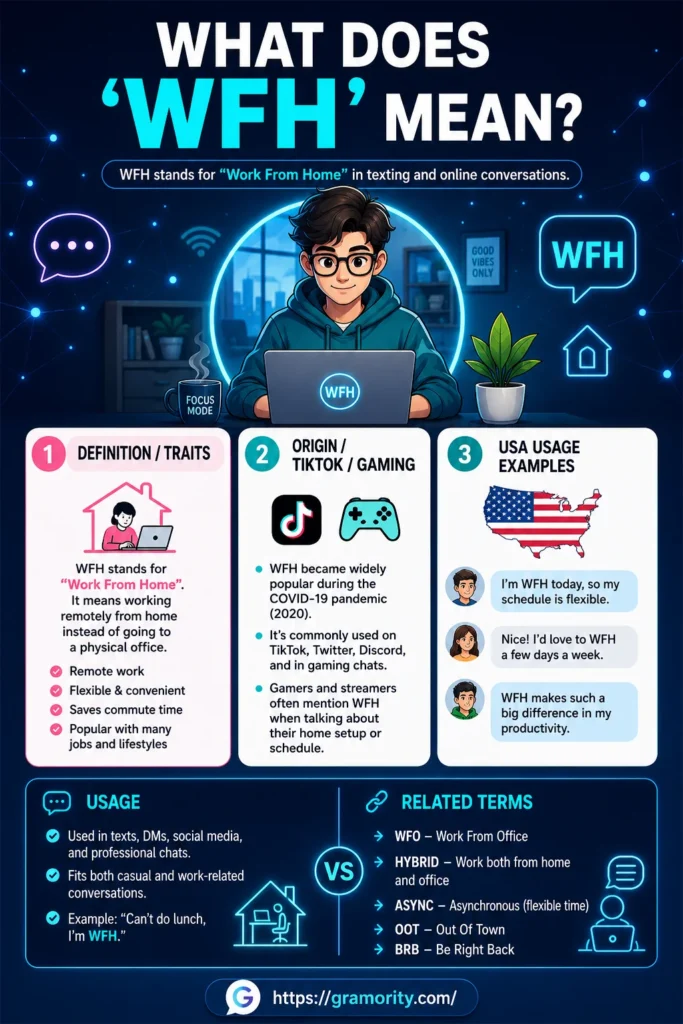
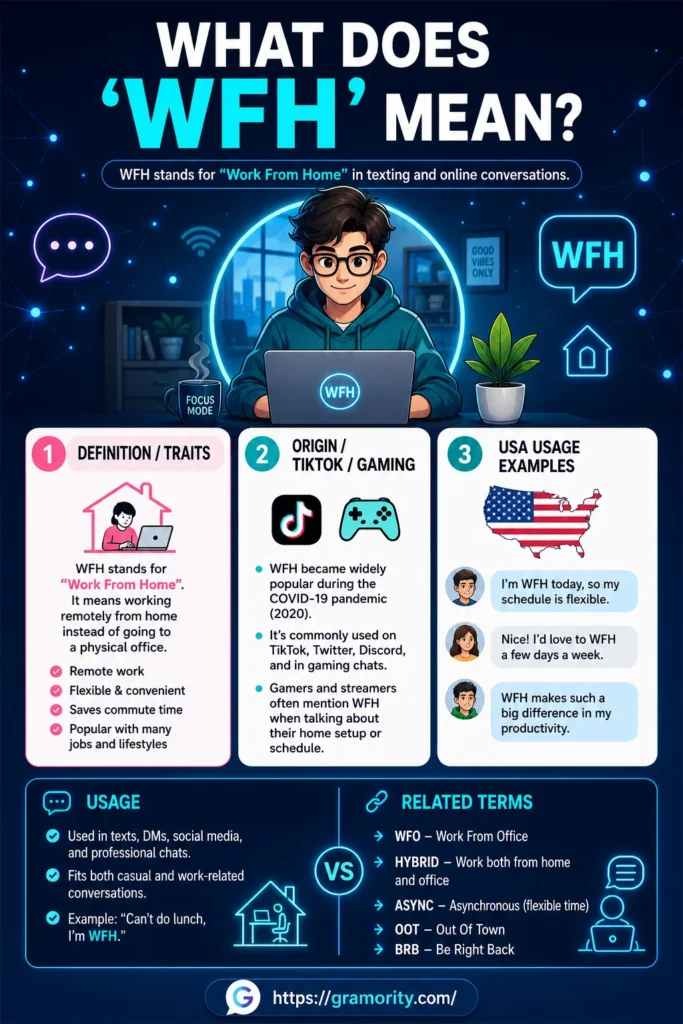
WFH is an acronym that explicitly stands for “work from home.” It refers to a professional arrangement where employees execute their daily job responsibilities remotely rather than commuting to a traditional centralized office space.
What does WFH stand for in texting?
In texting and casual messaging, WFH stands for “work from home.” It is a popular digital acronym used by professionals to instantly inform friends, family, or colleagues that they are executing their job duties remotely from their residence rather than commuting to a traditional office.
Why do professionals use the WFH acronym?
- Instant Status Updates: Quickly signals your physical location and availability boundaries in casual group chats or messaging apps like WhatsApp and Slack.
- Streamlined Digital Communication: Replaces lengthy explanations with a universally understood three-letter shorthand, maximizing typing efficiency during busy remote workdays.
- Setting Social Boundaries: Politely informs contacts that while you are technically at home, you are still actively on the clock and may be slow to respond to personal notifications.
Strong Introduction
The way we talk about our daily grind has completely transformed over the last few years.
If you spend any time scrolling through text messages, Slack channels, or social media feeds, you have undoubtedly come across this ubiquitous three-letter abbreviation.
People toss it around casually in group chats, use it as a legitimate excuse for declining social invitations, and build entire lifestyle aesthetics around it.
Understanding exactly what this term implies helps clear up the daily confusion surrounding modern scheduling.
It lets you know instantly whether a friend is available for a spontaneous coffee run or chained to their laptop fighting a spreadsheet emergency.
Let us dive deep into the cultural phenomenon of this remote working staple and unpack how it silently dictates our modern social calendar.
WFH – Quick Meaning
At its core, WFH is simply shorthand for operating out of your residential space instead of a corporate headquarters.
It bridges the gap between professional life and domestic comfort, acting as both a noun and an adjective in casual conversation.
- It denotes geographic flexibility and the elimination of a daily commute.
- It often implies wearing professional attire only from the waist up for video calls.
- It highlights a blending of personal boundaries and career tasks.
“Sorry I can’t hit the gym at 2 PM, I’m on WFH duty today and my boss is strict.”
“Are you WFH tomorrow or heading into the downtown office?”
“My WFH setup involves far too many snacks and an overly affectionate cat.”
Origin & Background
The acronym gained massive traction during the global shifts of 2020, but the concept of remote labor has roots much further back in telecommunications history.
Originally confined to tech circles and freelance contractors, the terminology exploded into mainstream vernacular when corporate America shifted to emergency living-room workspaces.
Social media platforms like TikTok and Instagram accelerated its evolution into everyday slang, spawning countless memes about Zoom fatigue and sweatpants.
What began as a strict public health necessity quickly morphed into a highly coveted employee benefit and a defining marker of modern white-collar culture.
The meaning evolved from a temporary survival tactic into a permanent lifestyle choice that permanently altered urban real estate and social rhythms.
Real-Life Conversations
Sarah A: Hey, are we still on for lunch downtown today?
Jessica B: I wish! I’m stuck on WFH duty until 5 PM thanks to back-to-back audits.
Mark A: Can you review this pitch deck before the client meeting?
David B: Give me twenty minutes, I’m in full WFH focus mode with my headphones on.
Chloe A: Why aren’t you answering my TikTok tags?
Ethan B: Because I’m pretending to be a productive employee during my WFH hours.
Riley A: Are you coming into the office this week at all?
Jordan B: Only on Wednesday. The rest of the week is pure uninterrupted WFH bliss.
Emotional & Psychological Meaning
Using this acronym often signals a subtle boundary negotiation between relaxation and professional obligation.
When people text this abbreviation, they are usually subconsciously broadcasting a desire for focus, comfort, or sometimes just a plea not to be disturbed.
It reveals a collective cultural shift where personal autonomy over one’s environment is prioritized over physical surveillance by management.
I remember the exact moment I realized my living room had become my boardroom.
Sitting at my dining table with a laptop balanced next to a coffee mug, I felt an odd mix of liberating freedom and claustrophobic confinement.
Sending that simple three-letter text to my friends became my way of explaining why I couldn’t just drop everything and chat, bridging the gap between my dual realities.
Usage in Different Contexts
On social media platforms, the term is frequently used to romanticize cozy morning routines, aesthetic coffee setups, and flexible afternoon habits.
When interacting with friends and romantic partners, it serves as a practical status update that dictates availability and response times.
In professional settings, it functions as a clear logistical indicator that helps colleagues understand why someone is absent from the physical boardroom.
Navigating between a casual tone with buddies and a serious tone with management requires knowing exactly when to drop the acronym into conversation smoothly.
When NOT to Use It
You should avoid dropping this abbreviation in formal job applications, cover letters, or during high-stakes executive negotiations where spelling out the full phrase demonstrates professionalism.
Be sensitive when communicating with individuals in retail, manufacturing, or healthcare who do not have the luxury of remote flexibility.
Tossing it around carelessly can sometimes read as tone-deaf or overly casual to those enduring grueling daily commutes or physically demanding shifts.
Always prioritize clear, inclusive communication over trendy slang to ensure you never alienate someone on your contact list.
Common Misunderstandings
Some people mistakenly assume the acronym implies a day off or an exceptionally relaxed schedule, leading to frustration when response times are slow.
Others confuse it with freelance independence, forgetting that remote employees still adhere to strict corporate hours and structured team meetings.
The literal interpretation often clashes with the figurative reality of intense screen time and demanding virtual oversight from managers.
Clarifying your actual availability prevents awkward friction between friends expecting immediate social interaction and coworkers needing project updates.
Comparison Table
| Feature | Similar Slang | Opposite Meaning | Related Expressions |
| Concept | Telecommute | RTO (Return to Office) | Zoom fatigue |
| Vibe | Remote | Commuting | Hybrid schedule |
| Usage | Casual text | Corporate memo | Flexible hours |
“Key Insight”
Grasping the subtle nuances of remote labor terminology ensures you stay perfectly aligned with the rapidly changing rhythms of modern interpersonal communication.
Variations / Types
Remote Work
Operating entirely outside a traditional corporate headquarters on a permanent basis.
Hybrid Model
Splitting the working week between residential focus and centralized office collaboration.
Telecommuting
The classic technical term for traveling to work via digital networks rather than physical transit.
Distributed Team
An organizational structure where staff members operate from completely different geographical locations globally.
Virtual Office
A digitized workspace setup enabling collaboration without physical proximity.
Flexitime
Adjusting daily operational hours to suit personal lifestyle needs while working remotely.
Digital Nomad
Traveling the world continuously while executing job duties from a laptop.
Home Office
A dedicated room or quiet corner in a residence utilized exclusively for career tasks.
Telework
A broader bureaucratic term encompassing any form of digital operational execution.
Out of Office
The traditional status indicator that has now been heavily modified by remote living arrangements.
How to Respond When Someone Uses It
Casual replies
“Nice! Enjoy the sweatpants life today.”
“Save me a seat on the couch for lunch.”
Funny replies
“Make sure you actually log in today instead of napping.”
“Are you really working, or just staring at the fridge?”
Mature replies
“Understood, let’s catch up once your shift wraps up.”
“Sounds good, I’ll email you the details so you can review them remotely.”
Respectful replies
“Thanks for the heads up on your schedule, I’ll message you later.”
“I appreciate you letting me know your operational setup today.”
Regional & Cultural Usage
In Western corporate cultures, the acronym is deeply associated with personal freedom, achieving work-life balance, and casual dress codes.
Across many Asian professional environments, remote setups have historically faced more skepticism, though global internet usage is rapidly accelerating its acceptance.
Middle Eastern business hubs have embraced hybrid models enthusiastically, blending traditional face-to-face meetings with flexible remote operations.
Generational friction often appears between older managers preferring physical presence and younger Millennials or Gen Z professionals demanding absolute location flexibility.
Bridging these cultural gaps requires understanding that the core abbreviation carries vastly different emotional weight depending on local corporate traditions.
Is It Safe for Kids?
The term is entirely benign, strictly professional, and perfectly safe for younger audiences to encounter in everyday conversations.
It simply describes a modern operational method rather than containing any mature subtext, hidden double meanings, or inappropriate slang.
Children are likely to encounter it casually as they watch older family members navigate their daily professional tasks from the living room.
You do not need to worry about filtering this abbreviation out of family discussions or school-age messaging threads.
FAQs
What does WFH stand for exactly?
It explicitly stands for “work from home,” describing remote professional execution.
Is WFH considered permanent slang or a temporary trend?
It has cemented itself as permanent vocabulary representing modern professional culture.
Can WFH be used as a verb in a sentence?
Yes, people frequently say things like, “I am going to WFH on Friday.”
How does WFH differ from hybrid?
WFH means operating entirely from home, while hybrid mixes home and office days.
Why do remote workers use this acronym so frequently?
It provides a quick, clear status update to friends and colleagues regarding their location.
Does the term imply a lack of productivity?
No, modern remote professionals are often just as productive, if not more so, than in-office staff.
Final Thought
Navigating the vocabulary of modern connectivity helps us stay perfectly in tune with each other’s busy lives.
This little abbreviation does heavy lifting in explaining boundaries, schedules, and lifestyle choices in the digital age.
Embrace using it confidently to streamline your daily Gramority updates and keep your remote work statistics conversations crystal clear.
Communication flows much smoother when everyone understands the simple realities behind the screen.