What Does TF Mean?
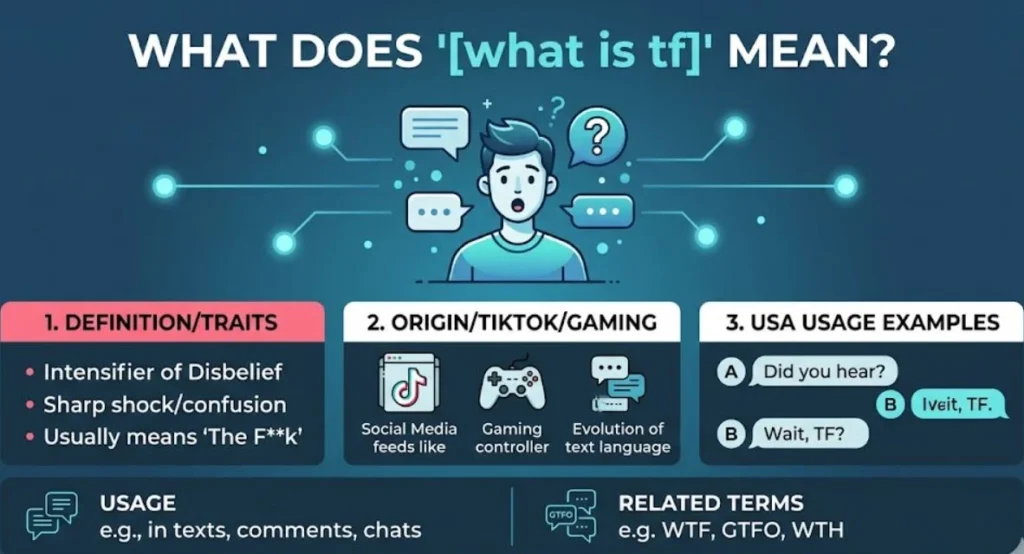
what is tf, In digital communication, “TF” is a widely popular shorthand acronym that stands for “the fk.” It is primarily used as an intensifier in text messages and social media comments to express absolute disbelief, sudden shock, extreme confusion, or intense frustration regarding an unexpected situation.
TF meaning
Have you ever been scrolling through a fast-paced group chat or browsing a viral video comment section and felt a sudden roadblock when a two-letter acronym popped up? Modern text messaging moves at a lightning-fast pace where shorthand rules the day, leaving many everyday readers searching for quick clarity.
People frequently search for this specific term because its actual meaning depends entirely on conversational context, emotional undertones, and punctuation choices. Missing the subtle vibe behind those two letters can lead to misinterpreting a close friend’s harmless venting session or completely overlooking a major emotional shift in a group dynamic. By understanding exactly what this phrase conveys, you can confidently navigate contemporary American digital culture without feeling out of the loop.
What Is TF – Quick Meaning
At its core, this expression serves as a quick linguistic amplifier to show that your jaw has dropped or your patience has worn thin. It condenses a massive burst of raw human emotion into two simple characters.
- Primary Translation: The fk
- Core Emotions: Extreme bewilderment, shock, annoyance, or playful incredulity
- Platform Presence: TikTok comment sections, Instagram direct messages, iMessage, and X (formerly Twitter)
“Wait, TF just happened?”
“Why TF did nobody tell me the plans changed?”
“Honestly, TF is wrong with people today?”
Origin & Background
While it feels like a native product of the modern smartphone era, the phrase behind the acronym has deep roots in spoken American English. For over a century, intensifiers like “the hell” or “the deuce” were added to questions to show frustration or surprise. By the mid-to-late 20th century, a sharper four-letter alternative took over spoken street slang, independent music genres, and cinematic dialogue across the United States.
The transition into the two-letter abbreviation began gaining massive traction during the early days of internet chat rooms and cellular SMS limits. When every single character mattered for character counts or typing speed, phrases like “What the fk” naturally collapsed into “WTF,” which eventually evolved into the punchier, clipped variation of just “TF.”
The dramatic rise of vertical video culture on platforms like TikTok and Instagram Reels has solidified its place in modern daily dialogue. Content creators utilize it in video text overlays to bypass automated platform community guidelines and content filters while maintaining an authentic, edgy, and urgent conversational tone. Over the years, the expression has shifted from an offensive insult into a universal cultural reflex used to mark any situation that completely defies normal logic.
Real-Life Conversations
WhatsApp Chat
John: Hey man, are you still coming to the gym? The trainer said the session started ten minutes ago.
Tony: TF? He text me this morning saying we were moving the whole thing to tomorrow afternoon!
Instagram DM
Marcus: Look at this video of a guy trying to parallel park a massive moving truck into a tiny compact space.
Devon: TF! He literally hit the sports car behind him three separate times and just kept driving!
TikTok Comment Section
Chris: Did she really just pack her entire suitcase with nothing but loose raw potatoes for her flight?
Brandon: TF is going on on this app today? I need to log off immediately.
Text Message
Sarah: My apartment complex just sent an email saying the pool is closed for the entire summer due to a inspection failure.
Taylor: TF! In the middle of July? We need to go demand a discount on our rent right now.
Why Is It Viral?
This shorthand expression remains incredibly dominant in American text culture because it perfectly mimics the real-time speed of our collective thoughts. Modern life throws absurd news headlines, shocking viral videos, and sudden behavioral shifts at us faster than our brains can process them. Typing out a full, grammatically flawless sentence of disbelief takes too long when a situation demands an immediate reaction.
Furthermore, the phrase carries a distinct type of social capital within younger demographics in the United States. It signals an unfiltered, raw reaction that feels far more authentic than polite, traditional alternatives. In a digital world heavily focused on curation, filters, and aesthetic presentation, utilizing this acronym injects a healthy dose of reality and raw human emotion into everyday conversations.
Emotional & Psychological Meaning
Psychologically, using this abbreviation acts as an emotional release valve for the sender. Text messages naturally lack physical gestures, vocal inflections, and immediate facial expressions. Because standard black-and-white text can often feel cold or ambiguous, adding a sharp modifier signals to the recipient that the sender is experiencing a strong, visceral reaction in real life.
It reveals a broader shift in how we connect online through our screens. We no longer just share basic data or updates; we share immediate psychological states. When someone sends this acronym, they are inviting you into their personal space of confusion or awe, demanding that you match their emotional frequency.
Imagine working incredibly hard on a massive shared project for weeks. Suddenly, a notification pops up showing that the entire database was accidentally deleted by a new intern. Your stomach drops, your heart rate spikes, and your brain struggles to find standard words. Sending those two letters to your trusted coworker instantly establishes a deep, empathetic connection of shared disbelief without needing a long, exhausting explanation.
Usage in Different Contexts
Social Media
On public comment feeds, this slang functions as a crowd-pleasing exclamation point. It highlights bizarre video content, emphasizes comedic timing, or calls out ridiculous behavior in public threads to gather likes and quick agreement from complete strangers.
Friends & Relationships
Among close peers, the term is highly flexible and adaptive. It can range from aggressive venting about a terrible day at school or work to a lighthearted, sarcastic response to a funny meme. The psychological safety established between close friends allows the acronym to lose its harsh edge and become a tool for playful daily banter.
Work & Professional Settings
Using this term in a professional email or corporate messaging platform like Slack or Teams is highly risky. Even in relaxed startup environments, it violates baseline professional standards and can easily be interpreted as hostile, aggressive, or deeply unpolished by management.
Casual vs. Serious Tone
The ultimate meaning depends heavily on punctuation choices and supporting emojis. Paired with a skull emoji, it implies hilarious, lighthearted confusion. Paired with a single, cold period, it signals genuine, unamused frustration that requires the reader to step back and tread lightly.
When NOT to Use It
Navigating the boundaries of modern language requires a strong sense of social awareness and emotional intelligence. It is absolutely crucial to avoid this acronym when communicating with figures of traditional authority, including corporate managers, academic advisors, older relatives, or new clients.
Additionally, it should be completely avoided during sensitive conversations involving personal grief, deep boundary settings, or serious relationship conflicts. In those moments, using aggressive profanity shortcuts can easily escalate a minor misunderstanding into a major argument. Maintaining respectful communication spaces requires knowing when to trade casual internet shorthand for clear, precise, and supportive language.
Common Misunderstandings
The most frequent point of confusion surrounding this slang involves tone misinterpretation. Because the literal phrase behind the letters contains a harsh profanity, older recipients or individuals unfamiliar with internet text patterns may interpret the message as a direct personal attack rather than a generalized statement of surprise.
Another mistake is confusing it with alternative acronyms or assuming it represents a basic typo. Readers completely new to modern chat patterns often mistake it for a broken attempt at typing an entirely different phrase, turning a harmless joke into a stressful digital stand-off.
Slang Comparison Table
| Slang Term | Core Meaning | Emotional Vibe | Contextual Intensity |
| TF | The f**k | Sharp disbelief or localized confusion | Medium to High |
| WTF | What the f**k | Universal, wide-eyed shock or anger | Very High |
| SMH | Shaking my head | Quiet disappointment or mild disapproval | Low to Medium |
| WTH | What the hell | Softer, mainstream version of surprise | Medium |
| GTFO | Get the f**k out | High-energy dismissal or total shock | Extremely High |
Key Insight
While “WTF” acts as a loud, all-encompassing siren of disbelief, the shorter variant serves as a targeted emotional laser, pinpointing specific moments of absolute absurdity within a fast-moving chat.
Variations & Types
- WTF (What the fk): The foundational three-letter phrase used for massive, undeniable shock across the internet.
- DTF (Down to fk): A completely different, romantically explicit slang term that should never be confused with simple confusion.
- TFW (That feeling when): Used to introduce a highly relatable situational meme, photo, or personal story.
- TBF (To be fair): A conversational bridge used to introduce an objective counterargument during a debate.
- TFTI (Thanks for the invitation): A sarcastic or genuine acknowledgment of being included or left out of social plans.
- TFw (Transformation): Often found within digital art or online gaming communities to describe character shifts.
- TF (Twisted Fate): A specific character reference exclusive to popular multiplayer gaming communities.
- TF (Too Funny): A rare, wholesome alternative used in older text circles to react to an excellent joke.
- STFU (Shut the fk up): A highly aggressive command telling someone to stop talking immediately.
- IDGAF (I don’t give a fk): An expression showing complete apathy, indifference, or lack of care about a situation.
How to Respond When Someone Uses It
Casual Replies
“I know, right? It makes absolutely zero sense to me either.”
“Literally my exact reaction when I saw the notification pop up.”
Funny Replies
“Welcome to the simulation, things get weirder here every single day.”
“Don’t ask me how it happened, I just work here.”
Mature Replies
“It is definitely a confusing situation, let’s take a look at the details together.”
“Let’s pause for a second and figure out the best way to handle this.”
Respectful Replies
“I completely understand your frustration, let me clarify what happened.”
“That was definitely unexpected, let’s look at the options we have left.”
Regional & Cultural Usage
Western Digital Culture
In the United States, this term is deeply embedded within everyday digital conversations, transitioning seamlessly across diverse urban social circles, online gaming lobbies, and viral pop culture spaces.
Global Internet Spaces
While understood globally due to the massive reach of American media, international users in non-English speaking regions often prefer localized profanities or specific regional emojis to express identical feelings of shock.
Generational Differences
Gen Z and Gen Alpha use the two-letter version fluidly, viewing it as a standard conversational spice rather than true vulgarity. Millennials are far more likely to lean on the traditional, full “WTF,” while older generations often view the expression as unnecessarily crude, aggressive, or completely confusing.
Is It Safe for Kids?
This slang is generally not considered safe for young children due to the explicit adult profanity forming the structural backbone of the acronym. Parents monitoring digital devices should look for it as an indicator that their children are interacting within older, more mature online spaces where adult language and complex internet subcultures are common.
FAQs
Does TF always mean something bad in text messages?
Not necessarily. While it frequently signals frustration or annoyance, it is just as commonly used to express hilarious disbelief or pure amazement at a positive, shocking event like a surprise party or an incredible sports play.
What is the structural difference between WTF and TF?
The difference lies entirely in emphasis and placement. “WTF” is a standalone, loud question of shock, while the shorter version is a punchy, conversational modifier inserted directly inside a sentence to amplify a specific thought.
Can I use TF in a professional company Slack channel?
It is highly recommended to keep this term completely out of professional communication platforms to prevent serious misunderstandings, maintain professional boundaries, and ensure clear workplace standards.
Is TF considered a form of cyberbullying?
On its own, it is simply an expression of surprise or shock. However, if it is targeted directly at a specific individual to demean, mock, or intimidate them in public comment spaces, it can quickly become part of harmful online behavior.
Why do people type TF instead of writing the full words out?
Typing out the abbreviated version saves valuable time, keeps digital dialogue moving at a natural conversational speed, and successfully helps users bypass strict content moderation filters on automated video platforms.
Can TF mean something else in specific online hobbies?
Yes, in gaming communities it often refers to specific characters or items, and in retail spaces it can stand for brands like Tom Ford, making context incredibly important.
Final Thought
Mastering contemporary American internet speak is all about recognizing the delicate balance between casual cultural trends and effective interpersonal communication. Shorthand terms like this one provide a brilliant, high-energy way to mirror our inner thoughts and build instant, authentic emotional connections in group chats.
Embrace the evolving patterns of modern language with complete confidence, but always remember to stay mindful of your specific audience. If you want to dive deeper into perfecting your digital voice and staying ahead of modern text trends, explore the comprehensive language guides over at Gramority to elevate your daily communication skills. For more information on how fast-moving internet slang impacts modern global culture, check out the linguistic research updates on Merriam-Webster. Keep your conversations vibrant, stay curious, and never be afraid to learn the hidden meanings shaping our shared online world.