The landscape of modern digital communication changes overnight, leaving many people scratching their heads when a new abbreviation takes over their feeds. If you have spent any time scrolling through TikTok, reading comment sections on Instagram, or keeping up with trending discussions across the American internet, you have likely run into the phrase “yt people.”
What does yt people mean?
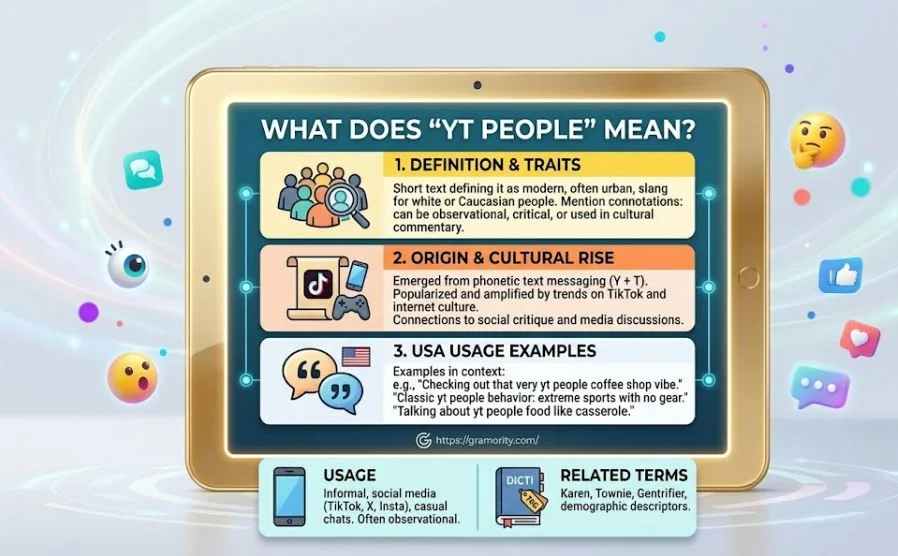
The term yt people is a phonetic digital slang abbreviation where “yt” stands for “white people.” When pronounced letter-by-letter (“Y-T”), it sounds exactly like “white.” It functions as an online shortcut for Caucasian individuals and cultural norms.
Why do people use this slang term online?
- Algorithmic Evasion: Content creators use it as an alternative text descriptor to discuss race without triggering social media filters or shadowbans.
- Typing Speed: It operates as a rapid mobile keyboard shortcut, similar to common internet acronyms and text-based abbreviations.
- Cultural Shorthand: It serves as a casual, modern linguistic marker popular among Gen Z and Millennial demographics in the United States.
What Does YT People Mean?
The term “yt people” is a shorthand digital abbreviation where “yt” stands for “white.” When used in text messages, social media posts, and online commentary, “yt people” simply translates to “white people.” It is a phonetic acronym, meaning that if you pronounce the letters “Y” and “T” out loud consecutively, it sounds exactly like the word “white.”
The surge in search volume around this term stems from a mix of generational gaps and platform-specific behaviors. Everyday internet users, parents, and professionals frequently search for this definition because they encounter it in public forums without any immediate context. It solves the massive confusion of mistaking the term for an abbreviation related to YouTube, which is the most common misinterpretation for those unfamiliar with modern text-based slang.
YT People – Quick Meaning
At its core, “yt” is a localized phonetic spelling used exclusively in digital spaces to reference Caucasian individuals or white cultural norms. It serves as a lightning-fast typing shortcut, much like using “bc” for “because” or “tomorrow” written as “tmr.”
- Primary Definition: A modern phonetic abbreviation for “white people.”
- Pronunciation Key: You do not pronounce it as a single word; you say the letters “Y-T” sequentially, which phonetically mimics “white.”
- Primary Platforms: TikTok, Instagram, X (formerly Twitter), and casual text message threads.
“I ran into a whole group of yt people hiking in the absolute pouring rain today without single umbrellas, true to form.”
“The aesthetic of that coffee shop is geared entirely toward yt people who love minimalism and five-dollar matcha.”
“Why do yt people in movies always go toward the creepy noise in the basement instead of running out the front door?”
Origin & Background
The acronym “yt” did not emerge out of a vacuum, nor was it invented by Gen Alpha or TikTok creators. Its roots trace back to early internet chat rooms, Black online spaces, and the era of character-limited text messaging in the late 2000s and early 2010s. Originally, it functioned as a simple keystroke-saving tool on standard flip-phone keypads.
As social media platforms grew, the usage of “yt” evolved from a pure shortcut into a tactical tool for navigating platform algorithms. On apps like TikTok and Instagram, automated content moderation systems frequently flag or suppress discussions around race, identity, and social dynamics. Users discovered that using standard racial descriptors sometimes led to their videos being shadowbanned or suppressed.
By substituting “white” with “yt,” creators could continue having open, candid discussions about systemic privilege, cultural differences, and social commentary without triggering automated community guideline filters. Over the past few years, the term drifted from a niche algorithmic workaround into the mainstream vocabulary of Gen Z and Millennials across the United States.
Real-Life Conversations
To understand how this slang functions in daily life, it helps to see it used across different digital mediums where younger Americans communicate.
TikTok Comment Section
Maya: That family vacation video is wild, they brought three coolers just for sparkling water.
Jordan: Lol it’s the most yt people thing I have ever seen in my life, living the dream.
Instagram DMs
Chloe: Are you going to that new country music festival downtown this weekend?
Sarah: Regular country or indie country? Because if it’s the first one, you know the crowd is just gonna be 99% yt people in cowboy boots.
Text Message Thread
Marcus: What’s the vibe at the new brunch spot your coworker recommended?
David: Food is amazing but the energy is very gentrified. Definitely tailored for yt people who love avocado toast on wooden boards.
WhatsApp Group Chat
Elena: My landlord told me he doesn’t believe in using AC until it hits 90 degrees outside.
Tariq: Classic yt people behavior, they will literally sweat out a heatwave just to save five dollars on the electric bill.
The rapid spread of this term in American culture is tied to the desire for fast, unfiltered cultural critique. It allows users to point out specific cultural habits, privileges, or stereotypes instantly, keeping the tone light or direct depending on the creator’s intent.
Emotional & Psychological Meaning
Beyond the literal letters, “yt people” carries a specific psychological weight in modern text communication. It often signals a sense of cultural observation, shared understanding, or systemic exhaustion. When a creator or writer uses “yt” instead of “white,” they are usually signaling to their audience that they are speaking from an insider perspective, often within minority communities, to discuss major social dynamics smoothly.
Using this abbreviation fosters a casual, shorthand intimacy among users who understand the systemic and cultural critiques behind it. For example, if someone describes an awkward corporate interaction involving “yt people,” they are implying a specific dynamic of corporate privilege or cultural mismatch without needing to write a multi-paragraph essay to explain it.
From an experiential standpoint, navigating these text shifts requires reading between the lines of digital subtext. When I first noticed the transition of this word from niche forums to mainstream comment sections, it became clear that it was more than a shortcut. It functions as an emotional buffer—a way to discuss complex, sometimes tense racial dynamics with a layer of casual digital distance.
Usage in Different Contexts
The appropriateness of “yt people” depends entirely on the digital ecosystem and the relationship between the speakers.
Social Media
On platforms like TikTok, X, and Instagram, the term is completely ubiquitous. It is used in memes, cultural commentary, and casual jokes without a second thought. It is the default spelling for many younger creators.
Friends & Relationships
In close-knit friend groups, particularly among Gen Z and Millennial circles, using “yt” in texts is viewed as casual and normal. It is treated like any other piece of modern slang, representing a shared cultural shorthand.
Work & Professional Settings
This is a critical boundary line. You should never use “yt people” in professional emails, Slack channels, corporate presentations, or formal communications. In the workplace, it reads as highly unprofessional, overly casual, and potentially inappropriate for a diverse corporate environment. Stick to standard, formal terminology when communicating with colleagues or clients.
Casual vs. Serious Tone
While often used in lighthearted memes about cultural quirks, “yt” can also appear in serious online discussions regarding social justice, gentrification, and representation. The context dictates whether the term is being used as a humorous observation or a piece of direct critique.
When NOT to Use It
Understanding digital literacy means knowing when to retire slang from your active vocabulary to avoid misunderstandings or causing accidental offense.
Do not use “yt people” in formal academic writing, legal documentation, or when speaking with individuals from older generations who are entirely disconnected from internet culture. To a baby boomer or an older Gen Xer, seeing “yt” will likely cause total confusion, or they might assume you are making a strange typo regarding YouTube.
Furthermore, context matters when discussing sensitive topics. If you are entering a deeply nuanced, serious discussion where precision of language is necessary to maintain respect and clarity, using internet shorthand can cheapen the impact of your words. It is vital to prioritize clear, empathetic communication over trendy abbreviations when the situation demands maturity. For comprehensive guides on modern communication styles and keeping your writing polished, exploring resources like Gramority can help you balance casual trends with professional clarity.
Common Misunderstandings
The single biggest misunderstanding surrounding “yt people” is the absolute conviction by many users that it stands for “YouTube people.” Given that YouTube is globally recognized by the letters YT, it is incredibly easy for someone looking at the phrase for the first time to assume it refers to content creators, influencers, or vloggers.
Another point of confusion involves the tone of the term. Some individuals view the abbreviation as inherently derogatory or exclusionary. While it can certainly be used in cynical or critical contexts, in the vast majority of daily internet usage, it serves as a neutral, descriptive shorthand or a tool to poke lighthearted fun at mainstream cultural tropes. Misreading the tone happens easily when text lacks visual or auditory cues, which is why observing how communities interact under videos provides the best lesson in its actual meaning.
Slang Comparison Table
To contextualize “yt people” within the broader world of modern cultural slang, it helps to see how it pairs against similar, opposite, or related digital expressions popular in the United States today.
| Slang Term | Core Meaning | Context of Usage | Tone / Vibe |
| YT People | White people | Cultural commentary, text shortcuts, algorithmic evasion | Casual, observational, direct |
| Townies | Local residents of a specific town | Used often by college students to describe permanent locals | Slightly exclusionary, localized |
| Gentrifier | Someone changing a neighborhood’s demographics | Real estate, cultural shifts, city development discussions | Critical, systemic, social |
| Karen | An entitled, demanding individual | Customer service complaints, public confrontations | Pejorative, mocking, critical |
| POC | People of Color | Formal and informal discussions on race and diversity | Respectful, inclusive, standard |
Key Insight
While terms like “Karen” target specific, negative public behaviors with a sharp edge, “yt people” operates primarily as a broad cultural and demographic identifier. It is designed for conversational speed and navigating online spaces rather than acting as a direct personal insult.
Variations & Types of “YT” Slang
The abbreviation “yt” has branched out into several distinct compound phrases and variations across social platforms.
- YT Folk: A slightly more conversational, old-school variation of “yt people” used to describe white families or communities.
- YT Boy / YT Girl: Specific descriptors used frequently in fashion, dating, or lifestyle memes on TikTok.
- YT Culture: A term used to analyze mainstream, suburban, or middle-class American pastimes and aesthetics.
- Very YT: An adjectival phrase used to describe an activity, outfit, or food choice that feels aggressively mainstream or white.
- YT Twitter: A subcultural reference to the dominant, non-minority spaces and trending topics on the X platform.
- YT Aesthetic: Used in interior design or fashion circles to describe ultra-minimalist, neutral-toned, beige styles.
- YT Privilege: A digital shorthand used in social justice spaces to discuss systemic advantages without triggering content filters.
- YT Behavior: A phrase tagged to videos showing people doing extreme sports, playing with wild animals, or engaging in quirky habits.
How to Respond When Someone Uses It
If someone drops this abbreviation in a text message thread or a comment on your post, your response should match the comfort level and context of your relationship.
Casual Replies
If a friend texts you a meme using the term, you can keep the energy exactly where it is.
“Lol stop, that is too accurate though.”
“Lmao why are we like this every single summer?”
Funny Replies
Leaning into the joke is a great way to show you match the digital literacy of the room.
“Don’t attack my people like that, pumpkin spice season is essential.”
“As a representative of the yt community, I formally accept this call-out.”
Mature Replies
If the term comes up in a broader, more serious discussion about neighborhood changes or social issues, keep your focus on the substance of the talk.
“That’s a fair point about how the demographics of that neighborhood have shifted so fast over the last three years.”
“I see what you mean about how that marketing campaign misses the mark for a diverse audience.”
Respectful Replies
If you feel uncomfortable with the shorthand but want to keep the dialogue open and constructive, redirect smoothly.
“I prefer looking at these community issues through a broader lens, but I get where your frustration is coming from.”
Regional & Cultural Usage
The way “yt people” is received changes drastically depending on geography, cultural backgrounds, and generational identity. Within Western culture, specifically inside the United States, Canada, and the United Kingdom, the term is native to digital platforms and is deeply understood by younger demographics who live online.
In contrast, if you look at Asian, Latin American, or Middle Eastern digital spaces, the term holds almost no relevance. Outside of Westernized, English-speaking internet circles, people rely on standard translations or localized slang terms to discuss demographic differences.
The divide is also incredibly apparent when looking at different age groups:
[Gen Z / Gen Alpha] --------> Use "yt" natively as a standard daily text shortcut.
[Millennials] --------------> Understand it fully; use it contextually or for algorithm safety.
[Gen X / Baby Boomers] ------> Frequently confuse it with "YouTube" or miss the meaning entirely.
According to data compiled by language tracking resources and major institutions like the Pew Research Center, digital linguistics among American youth rely heavily on phonetic compression to maximize typing speed on mobile devices. This explains why older generations find the term so foreign—their communication habits were formed around full-word keyboard typing rather than mobile screen gestures and character limitations.
Is It Safe for Kids?
From a digital safety standpoint, “yt people” is entirely safe for teenagers and younger kids to encounter online. It does not contain explicit language, adult content, or dangerous concepts. It is an entry-level piece of internet literacy.
However, parents should use its appearance as an opportunity to teach kids about context, nuance, and audience awareness in communication. A teenager needs to understand that while using internet shortcuts is completely fine when joking around with friends on Discord or TikTok, those same shortcuts can create a negative impression if used in school essays, college applications, or communications with employers.
Frequently Asked Questions
Does YT stand for YouTube?
In traditional tech spaces, yes, YT is the official abbreviation for YouTube. However, when written in phrases like “yt people” or “yt culture” on social media, it is a phonetic shortcut meaning “white.”
Is using the term “yt” considered offensive?
Generally, no. In mainstream internet culture, it functions as a neutral phonetic shorthand or a tool to bypass automated algorithm filters. However, tone and intent always dictate how a word is received.
How do you pronounce YT when reading it online?
You pronounce it by saying the letters “Y” and “T” out loud. The combination phonetically sounds like the word “white.”
Why do people use YT instead of just writing out the full word?
Users rely on it because it saves typing time on mobile devices and prevents social media algorithms from flagging or suppressing videos that discuss racial demographics and social issues.
When did this slang term first become popular?
While its roots go back to early internet forums, it gained massive, mainstream popularity across the United States between 2020 and 2022 due to the rise of cultural commentary videos on TikTok.
Can I use this term in professional settings?
No, you should avoid using it in corporate environments, emails, or workplace chats like Slack. It is strictly casual internet slang and reads as unprofessional in a business context.
Final Thought
Language is a living, breathing entity that reflects our cultural shifts, technological habits, and social environments. The phrase “yt people” is a perfect example of how modern internet users adapt their communication styles to move faster, connect intimately, and navigate the complex rules of social media algorithms.
Understanding these terms is not about changing the way you speak overnight; it is about building the cultural empathy and digital literacy needed to navigate the modern American landscape without feeling lost. The next time you see those two letters pop up on your timeline, you can read past the characters and confidently understand the exact cultural conversation unfolding right in front of you.
What does yt people mean? “YT” Slang Meaning, Origin & Cultural Context (2026 Guide)
The landscape of modern digital communication changes overnight. Consequently, these sudden shifts leave many people scratching their heads when a new abbreviation takes over their feeds. If you have spent any time scrolling through TikTok, reading comment sections on Instagram, or keeping up with trending discussions across the American internet, you have likely run into the phrase “yt people.”
What does yt people mean?
The term yt people is a phonetic digital slang abbreviation where “yt” stands for “white people.” When pronounced letter-by-letter (“Y-T”), it sounds exactly like “white.” It functions as an online shortcut for Caucasian individuals and cultural norms.
Why do people use this slang term online?
- Algorithmic Evasion: Content creators use it as an alternative text descriptor to discuss race without triggering social media filters or shadowbans.
- Typing Speed: It operates as a rapid mobile keyboard shortcut, similar to common internet acronyms and text-based abbreviations.
- Cultural Shorthand: It serves as a casual, modern linguistic marker popular among Gen Z and Millennial demographics in the United States.
What Does YT People Mean?
The term “yt people” is a shorthand digital abbreviation where “yt” stands for “white.” When used in text messages, social media posts, and online commentary, “yt people” simply translates to “white people.” It is a phonetic acronym. Therefore, if you pronounce the letters “Y” and “T” out loud consecutively, it sounds exactly like the word “white.”
The surge in search volume around this term stems from a mix of generational gaps and platform-specific behaviors. Everyday internet users, parents, and professionals frequently search for this definition. They usually look it up because they encounter it in public forums without any immediate context. Fortunately, this guide solves the massive confusion of mistaking the term for an abbreviation related to YouTube. That is the most common misinterpretation for those unfamiliar with modern text-based slang.
YT People – Quick Meaning
At its core, “yt” is a localized phonetic spelling. People use it exclusively in digital spaces to reference Caucasian individuals or white cultural norms. It serves as a lightning-fast typing shortcut, much like using “bc” for “because” or writing “tomorrow” as “tmr.”
- Primary Definition: A modern phonetic abbreviation for “white people.”
- Pronunciation Key: You do not pronounce it as a single word. Instead, you say the letters “Y-T” sequentially, which phonetically mimics “white.”
- Primary Platforms: TikTok, Instagram, X (formerly Twitter), and casual text message threads.
“I ran into a whole group of yt people hiking in the absolute pouring rain today without single umbrellas, true to form.”
“The aesthetic of that coffee shop is geared entirely toward yt people who love minimalism and five-dollar matcha.”
“Why do yt people in movies always go toward the creepy noise in the basement instead of running out the front door?”
Origin & Background
The acronym “yt” did not emerge out of a vacuum, nor did Gen Alpha or TikTok creators invent it. Its roots trace back to early internet chat rooms, Black online spaces, and character-limited text messaging. It became popular in the late 2000s and early 2010s. Originally, it functioned as a simple keystroke-saving tool on standard flip-phone keypads.
As social media platforms grew, the usage of “yt” evolved from a pure shortcut into a tactical tool. Users actively employed it for navigating platform algorithms. On apps like TikTok and Instagram, automated content moderation systems frequently flag or suppress discussions around race, identity, and social dynamics. Users discovered that using standard racial descriptors sometimes led to their videos being shadowbanned or suppressed.
By substituting “white” with “yt,” creators could continue having open, candid discussions. They safely analyzed systemic privilege, cultural differences, and social commentary without triggering automated community guideline filters. Over the past few years, the term drifted from a niche algorithmic workaround into the mainstream vocabulary. Now, Gen Z and Millennials across the United States use it daily.
Real-Life Conversations
To understand how this slang functions in daily life, it helps to see it used across different digital mediums where younger Americans communicate.
TikTok Comment Section
Maya: That family vacation video is wild, they brought three coolers just for sparkling water.
Jordan: Lol it’s the most yt people thing I have ever seen in my life, living the dream.
Instagram DMs
Chloe: Are you going to that new country music festival downtown this weekend?
Sarah: Regular country or indie country? Because if it’s the first one, you know the crowd is just gonna be 99% yt people in cowboy boots.
Text Message Thread
Marcus: What’s the vibe at the new brunch spot your coworker recommended?
David: Food is amazing but the energy is very gentrified. Definitely tailored for yt people who love avocado toast on wooden boards.
WhatsApp Group Chat
Elena: My landlord told me he doesn’t believe in using AC until it hits 90 degrees outside.
Tariq: Classic yt people behavior, they will literally sweat out a heatwave just to save five dollars on the electric bill.
The rapid spread of this term in American culture is tied to the desire for fast, unfiltered cultural critique. It allows users to point out specific cultural habits, privileges, or stereotypes instantly. As a result, it keeps the tone light or direct depending on the creator’s intent.
Emotional & Psychological Meaning
Beyond the literal letters, “yt people” carries a specific psychological weight in modern text communication. It often signals a sense of cultural observation, shared understanding, or systemic exhaustion. When a creator or writer uses “yt” instead of “white,” they are usually signaling to their audience that they are speaking from an insider perspective. They often do this within minority communities to discuss major social dynamics smoothly.
Using this abbreviation fosters a casual, shorthand intimacy among users who understand the systemic and cultural critiques behind it. For example, a user might describe an awkward corporate interaction involving “yt people.” By doing so, they imply a specific dynamic of corporate privilege or cultural mismatch. Thus, they avoid writing a multi-paragraph essay to explain it.
From an experiential standpoint, navigating these text shifts requires reading between the lines of digital subtext. When I first noticed the transition of this word from niche forums to mainstream comment sections, it became clear that it was more than a shortcut. It functions as an emotional buffer. Specifically, it provides a way to discuss complex, sometimes tense racial dynamics with a layer of casual digital distance.
Usage in Different Contexts
The appropriateness of “yt people” depends entirely on the digital ecosystem and the relationship between the speakers.
Social Media
On platforms like TikTok, X, and Instagram, the term is completely ubiquitous. Users drop it in memes, cultural commentary, and casual jokes without a second thought. Indeed, it is the default spelling for many younger creators.
Friends & Relationships
In close-knit friend groups, particularly among Gen Z and Millennial circles, using “yt” in texts is viewed as casual and normal. Friends treat it like any other piece of modern slang, representing a shared cultural shorthand.
Work & Professional Settings
This is a critical boundary line. You should never use “yt people” in professional emails, Slack channels, corporate presentations, or formal communications. In the workplace, it reads as highly unprofessional, overly casual, and potentially inappropriate for a diverse corporate environment. Therefore, stick to standard, formal terminology when communicating with colleagues or clients.
Casual vs. Serious Tone
While often used in lighthearted memes about cultural quirks, “yt” can also appear in serious online discussions. For instance, people use it when debating social justice, gentrification, and representation. The context dictates whether the term is being used as a humorous observation or a piece of direct critique.
When NOT to Use It
Understanding digital literacy means knowing when to retire slang from your active vocabulary. This helps you avoid misunderstandings or causing accidental offense.
Do not use “yt people” in formal academic writing, legal documentation, or when speaking with individuals from older generations. Older folks are entirely disconnected from internet culture. To a baby boomer or an older Gen Xer, seeing “yt” will likely cause total confusion. Alternatively, they might assume you are making a strange typo regarding YouTube.
Furthermore, context matters when discussing sensitive topics. If you are entering a deeply nuanced, serious discussion where precision of language is necessary to maintain respect and clarity, using internet shorthand can cheapen the impact of your words. It is vital to prioritize clear, empathetic communication over trendy abbreviations when the situation demands maturity. For comprehensive guides on modern communication styles and keeping your writing polished, exploring resources like Gramority can help you balance casual trends with professional clarity.
Common Misunderstandings
The single biggest misunderstanding surrounding “yt people” is the absolute conviction by many users that it stands for “YouTube people.” Given that YouTube is globally recognized by the letters YT, it is incredibly easy for someone looking at the phrase for the first time to assume it refers to content creators, influencers, or vloggers.
Another point of confusion involves the tone of the term. Some individuals view the abbreviation as inherently derogatory or exclusionary. While it can certainly be used in cynical or critical contexts, in the vast majority of daily internet usage, it serves as a neutral, descriptive shorthand. It is mostly a tool to poke lighthearted fun at mainstream cultural tropes. Misreading the tone happens easily when text lacks visual or auditory cues. Therefore, observing how communities interact under videos provides the best lesson in its actual meaning.
Slang Comparison Table
To contextualize “yt people” within the broader world of modern cultural slang, it helps to see how it pairs against similar, opposite, or related digital expressions popular in the United States today.
| Slang Term | Core Meaning | Context of Usage | Tone / Vibe |
| YT People | White people | Cultural commentary, text shortcuts, algorithmic evasion | Casual, observational, direct |
| Townies | Local residents of a specific town | Used often by college students to describe permanent locals | Slightly exclusionary, localized |
| Gentrifier | Someone changing a neighborhood’s demographics | Real estate, cultural shifts, city development discussions | Critical, systemic, social |
| Karen | An entitled, demanding individual | Customer service complaints, public confrontations | Pejorative, mocking, critical |
| POC | People of Color | Formal and informal discussions on race and diversity | Respectful, inclusive, standard |
Key Insight
While terms like “Karen” target specific, negative public behaviors with a sharp edge, “yt people” operates primarily as a broad cultural and demographic identifier. It is designed for conversational speed and navigating online spaces rather than acting as a direct personal insult.
Variations & Types of “YT” Slang
The abbreviation “yt” has branched out into several distinct compound phrases and variations across social platforms.
- YT Folk: A slightly more conversational, old-school variation of “yt people” used to describe white families or communities.
- YT Boy / YT Girl: Specific descriptors used frequently in fashion, dating, or lifestyle memes on TikTok.
- YT Culture: A term used to analyze mainstream, suburban, or middle-class American pastimes and aesthetics.
- Very YT: An adjectival phrase used to describe an activity, outfit, or food choice that feels aggressively mainstream or white.
- YT Twitter: A subcultural reference to the dominant, non-minority spaces and trending topics on the X platform.
- YT Aesthetic: Used in interior design or fashion circles to describe ultra-minimalist, neutral-toned, beige styles.
- YT Privilege: A digital shorthand used in social justice spaces to discuss systemic advantages without triggering content filters.
- YT Behavior: A phrase tagged to videos showing people doing extreme sports, playing with wild animals, or engaging in quirky habits.
How to Respond When Someone Uses It
If someone drops this abbreviation in a text message thread or a comment on your post, your response should match the comfort level and context of your relationship.
Casual Replies
If a friend texts you a meme using the term, you can keep the energy exactly where it is.
“Lol stop, that is too accurate though.”
“Lmao why are we like this every single summer?”
Funny Replies
Leaning into the joke is a great way to show you match the digital literacy of the room.
“Don’t attack my people like that, pumpkin spice season is essential.”
“As a representative of the yt community, I formally accept this call-out.”
Mature Replies
If the term comes up in a broader, more serious discussion about neighborhood changes or social issues, keep your focus on the substance of the talk.
“That’s a fair point about how the demographics of that neighborhood have shifted so fast over the last three years.”
“I see what you mean about how that marketing campaign misses the mark for a diverse audience.”
Respectful Replies
If you feel uncomfortable with the shorthand but want to keep the dialogue open and constructive, redirect smoothly.
“I prefer looking at these community issues through a broader lens, but I get where your frustration is coming from.”
Regional & Cultural Usage
The way “yt people” is received changes drastically depending on geography, cultural backgrounds, and generational identity. Within Western culture, specifically inside the United States, Canada, and the United Kingdom, the term is native to digital platforms. It is deeply understood by younger demographics who live online.
In contrast, if you look at Asian, Latin American, or Middle Eastern digital spaces, the term holds almost no relevance. Outside of Westernized, English-speaking internet circles, people rely on standard translations or localized slang terms to discuss demographic differences.
The divide is also incredibly apparent when looking at different age groups:
[Gen Z / Gen Alpha] --------> Use "yt" natively as a standard daily text shortcut.
[Millennials] --------------> Understand it fully; use it contextually or for algorithm safety.
[Gen X / Baby Boomers] ------> Frequently confuse it with "YouTube" or miss the meaning entirely.
According to data compiled by language tracking resources and major institutions like the Pew Research Center, digital linguistics among American youth rely heavily on phonetic compression. This technique helps maximize typing speed on mobile devices. Consequently, this explains why older generations find the term so foreign. Their communication habits were formed around full-word keyboard typing rather than mobile screen gestures and character limitations.
Is It Safe for Kids?
From a digital safety standpoint, “yt people” is entirely safe for teenagers and younger kids to encounter online. It does not contain explicit language, adult content, or dangerous concepts. Therefore, it is an entry-level piece of internet literacy.
However, parents should use its appearance as an opportunity to teach kids about context, nuance, and audience awareness in communication. A teenager needs to understand that while using internet shortcuts is completely fine when joking around with friends on Discord or TikTok, those same shortcuts can create a negative impression if used in school essays, college applications, or communications with employers.
Frequently Asked Questions
Does YT stand for YouTube?
In traditional tech spaces, yes, YT is the official abbreviation for YouTube. However, when written in phrases like “yt people” or “yt culture” on social media, it is a phonetic shortcut meaning “white.”
Is using the term “yt” considered offensive?
Generally, no. In mainstream internet culture, it functions as a neutral phonetic shorthand or a tool to bypass automated algorithm filters. However, tone and intent always dictate how a word is received.
How do you pronounce YT when reading it online?
You pronounce it by saying the letters “Y” and “T” out loud. The combination phonetically sounds like the word “white.”
Why do people use YT instead of just writing out the full word?
Users rely on it because it saves typing time on mobile devices. Furthermore, it prevents social media algorithms from flagging or suppressing videos that discuss racial demographics and social issues.
When did this slang term first become popular?
While its roots go back to early internet forums, it gained massive, mainstream popularity across the United States between 2020 and 2022. This shift happened due to the rise of cultural commentary videos on TikTok.
Can I use this term in professional settings?
No, you should avoid using it in corporate environments, emails, or workplace chats like Slack. It is strictly casual internet slang and reads as unprofessional in a business context.
Final Thought
Language is a living, breathing entity that reflects our cultural shifts, technological habits, and social environments. The phrase “yt people” is a perfect example of how modern internet users adapt their communication styles to move faster, connect intimately, and navigate the complex rules of social media algorithms.
Understanding these terms is not about changing the way you speak overnight. Instead, it is about building the cultural empathy and digital literacy needed to navigate the modern American landscape without feeling lost. The next time you see those two letters pop up on your timeline, you can read past the characters. As a result, you will confidently understand the exact cultural conversation unfolding right in front of you.